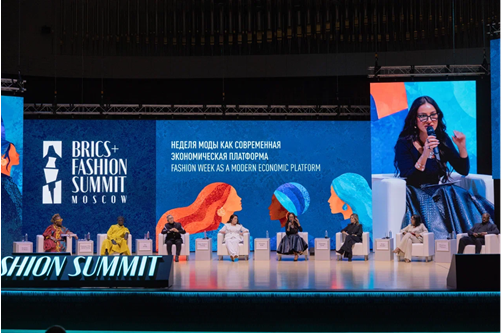
African designer clothing should be available to shoppers through everyday retail, says Stephen Manzini, Founder & CEO, Soweto Fashion Week; President, South African Fashion Association. Speaking at the BRICS+ Fashion Summit in Moscow, he called for closer cooperation between designers, retailers and international partners to make local collections more accessible to consumers.
The BRICS+ Fashion Summit, the largest international business forum for the fashion industries of fast-growing economies, brought together retailers, heads of fashion associations and investors from more than 60 countries in Moscow. The program featured prominent voices from across the African continent, who discussed production costs, local brands’ access to retail channels and the requirements of international markets. Participants in the Summit’s business program also included representatives of the International Apparel Federation, PT Pan Brothers Tbk, FARM Rio and Wildberries, as well as experts featured on the BoF 500 list of influential figures in global fashion. The forum ran alongside Moscow Fashion Week.
Manzini noted that the cultural diversity showcased at fashion shows and festivals is not always reflected in store assortments. Shoppers looking for clothing with a distinctive local identity should be able to buy it. In his view, this requires closer ties between designers, retailers, boutiques and craft stores, as well as the development of international partnerships that facilitate the exchange of products and expertise.
Participation in the BRICS+ Fashion Summit in Moscow has already helped Soweto Fashion Week establish business relationships with colleagues and retailers from Brazil and Sri Lanka. As Stephen Manzini put it: “The BRICS+ Fashion Summit is creating a new global platform where emerging fashion markets can connect, collaborate and do business. It moves the conversation beyond traditional fashion capitals and gives countries like South Africa an opportunity to contribute to the global fashion agenda”.
Colleen Eitzen, co-founder of the South African retail chain The Space, shared practical insights into working with local designers. The chain stocks their collections in its stores and takes a commission on sales. This gives brands access to physical retail without the expense of running their own outlets. According to Eitzen, designers can track sales in real time, seeing which styles, colours and sizes sell and which remain unsold. This data allows them to respond quickly to demand. The Space’s sales consultants maintain personal relationships with customers and let them know when new pieces from their favourite designers arrive.
Brian James Kihindas, director of Nairobi Fashion Week and Kenya Fashion Council in Kenya, drew attention to the costs associated with international trade. During a discussion on certification, he explained that small brands struggle to compile the required production data and cover the costs of procedures needed to sell their products abroad. He proposed greater cooperation between countries, the establishment of regional product-testing laboratories and support to help designers navigate the requirements of different markets. In his view, such measures should take the resources of small businesses into account.
Nana Addo Tamakloe, CEO and Founder of Accra Fashion Week in Ghana, spoke about competition in the domestic market. In his assessment, large-scale imports of second-hand clothing make it harder for local manufacturers to operate: smaller brands struggle to compete at the lower end of the price spectrum, while designer pieces remain accessible mainly to affluent consumers. He described access to international markets as essential to the survival of many local brands.
Experts from across the continent, whose national industries operate under widely differing economic conditions, need a shared platform for regular meetings, and the BRICS+ Fashion Summit has become just such a venue. The business forum featured African representatives from the continent’s eastern coast to its southern reaches and the islands of the Indian Ocean: Mahlet Teklemariam, Founder of Hub of Africa Fashion Week and BoF 500 Member (Ethiopia); Mmantlha Sankoloba, CEO of the Botswana Exporters and Manufacturers Association (Botswana); Kalistu Ramos Mukoroli, Director of MTC Windhoek Fashion Week (Namibia); Rick Anderson, Director of Mauritius Fashion Festival Week (Mauritius); and Tery Carola, President and CEO of Seychelles Fashion Week (Seychelles).